Church Heating Solutions: Electric Radiant Heaters and Warm Air Replacement
Churches and places of worship are some of the most challenging buildings to heat. High ceilings, large volumes of air, stone walls, limited insulation and intermittent use all work against conventional heating systems. Whether you need discreet low-glare or zero-glare electric radiant heating for a listed building or a modern replacement for an obsolete warm air system, there are effective solutions available.

Heating a church or place of worship presents unique challenges that most commercial and industrial buildings do not face. The building is often tall with vaulted or high ceilings. The walls are thick stone or masonry with little or no insulation. The building is used intermittently rather than continuously, sometimes only for a few hours each week. And in many cases the building is listed or has heritage restrictions that limit what can be installed and where.
Despite these challenges, the congregation and visitors still need to feel warm during services and events. A church that is uncomfortably cold discourages attendance, shortens the time people are willing to stay and makes the building less attractive for weddings, concerts, community events and other bookings that generate revenue for the church.
Why Electric Radiant Heating Works So Well in Churches
Electric radiant heaters are one of the most effective heating technologies for churches and places of worship. Unlike warm air systems that heat the air in the building (which then rises straight to the ceiling in a tall church), radiant heaters emit infrared energy that warms people and surfaces directly. The warmth is felt immediately by the congregation without needing to heat the entire volume of air in the building first.
This is particularly important in churches because:
-
No heat stratification: In a building with a 10-metre vaulted ceiling, a warm air system would need to heat the entire volume of air before the congregation at floor level feels any benefit. Radiant heat travels directly to the people and pews without rising to the ceiling
-
Instant warmth: Electric radiant heaters reach full output within seconds of being switched on. There is no preheat period. The congregation feels warm from the moment they sit down, even if the building itself is cold
-
Intermittent use: Churches are typically heated for services a few times a week rather than continuously. Radiant heating is ideal for intermittent use because it does not need to bring the entire building up to temperature. It heats the people, not the building
-
No gas supply or flue needed: Electric radiant heaters need only an electrical connection. There is no gas pipework, no flue penetrating the roof and no combustion products inside the building. This is a significant advantage for listed buildings where external alterations are restricted
-
Quiet operation: Radiant heaters produce no fan noise. This is essential in churches where quiet is important during services, prayers and music
Low-Glare and Zero-Glare Electric Radiant Heaters for Churches
One of the most common concerns about electric radiant heaters in churches is visible glare from the heating element. A bright orange glow from a heater would be distracting and visually inappropriate in a church setting. This is why low-glare and zero-glare radiant heaters are specifically designed for environments where the appearance of the heater matters as much as its performance.
Tansun Sorrento Ceramic: Zero Visible Glare
The Sorrento Ceramic is a zero-glare electric radiant heater. It uses a ceramic front panel that completely eliminates the visible orange glow from the heating element while still delivering the same powerful infrared heat output as a standard shortwave radiant heater. From the congregation's perspective, the heater is completely dark when operating. There is no visible light from the element at all.
-
Zero visible glare: Ceramic front panel completely blocks the orange glow of the element
-
Powerful infrared output: Same heat performance as standard shortwave radiant heaters
-
Discreet appearance: Can be mounted at high level without creating a visual distraction during services
Tansun Linea: Slim Contemporary Radiant
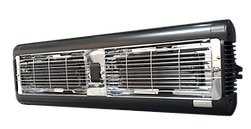
The Linea is a slim, contemporary electric radiant heater that can be wall-mounted or ceiling-mounted. Its modern profile works well in churches that have been modernised or in newer church buildings and community halls where a visible but attractive heater is acceptable.
-
Slim, modern design: Contemporary profile suits modernised churches and community halls
-
Wall or ceiling mounted: Flexible positioning to suit different building layouts
-
Effective zone heating: Heat specific areas like the nave, chancel or community rooms
Replacing Obsolete Warm Air Heating in Churches
Many churches across the UK still rely on warm air heating systems that were installed decades ago. These older systems are now reaching the end of their working life with parts no longer available, efficiency levels well below modern standards and repair costs that no longer make economic sense. When an old warm air system fails, the church is left without heating and needs a replacement that can be installed without major disruption to the building or the schedule of services.
Hadar Vortex
The Hadar Vortex is a gas-fired warm air heater available in non-condensing and condensing configurations from 24 to 99 kW. With the Supercell 4-pass heat exchanger, it delivers heating, ventilation and cooling from a single unit. The Vortex is a practical replacement for many obsolete warm air heaters found in churches, offering modern efficiency, low emissions and year-round climate control from one compact unit.
-
24 to 99 kW: Covers a wide range of church sizes from small chapels to large parish churches
-
Heating, ventilation and cooling: Year-round climate control from a single unit
-
Supercell 4-pass heat exchanger: High efficiency for lower fuel bills
Hadar Replicant: Built to Match Your Obsolete Heater
One of the biggest challenges when replacing an obsolete warm air heater in a church is that the original unit no longer exists. The manufacturer may have ceased trading, the model is discontinued and no direct replacement is available in the same dimensions. This is a particular problem in churches where the heater sits in a purpose-built enclosure, a plant room with limited access or a space where the ductwork, flue route and electrical connections are all built around the exact size and shape of the original unit.
The Hadar Replicant solves this problem. Hadar can supply a warm air heater built to the same dimensions as the obsolete unit it replaces. This means the new heater fits into the existing space without the need to modify enclosures, rebuild plant rooms, alter ductwork connections or reposition flue routes. The Replicant is built around modern high-efficiency components but in a casing designed to match the footprint of the heater it is replacing.
-
Matches the dimensions of your obsolete heater: Fits into the existing space without modifications to enclosures, plant rooms or ductwork
-
Modern high-efficiency components: New burner technology, improved heat exchanger and modern controls inside a custom-sized casing
-
Minimal disruption: No need to rebuild surrounding infrastructure. The new heater drops into the space the old one occupied
-
Ideal for churches: Where the original heater was installed during construction and the building has been designed around it
Choosing the Right Approach for Your Church
-
Listed building with heritage restrictions: Electric radiant heaters (Sorrento Ceramic or Linea) require no flue, no gas pipework and no external alterations
-
Replacing a failed warm air system: The Hadar Vortex provides modern heating, ventilation and optional cooling from a single unit
-
Obsolete heater in a purpose-built enclosure: The Hadar Replicant is built to the same dimensions as the unit it replaces, avoiding costly modifications
-
Infrequently used building: Electric radiant heaters deliver instant warmth without preheating the building, ideal for a church used a few hours per week
-
Community hall attached to church: A mix of radiant heaters in the worship space and a Vortex warm air unit in the hall can provide the best of both approaches
Every church is different. The right heating solution depends on the building size, ceiling height, construction type, how often the building is used, the existing fuel supply and any heritage or planning restrictions. Contact Hadar Industries today for a free site survey and recommendation on the best heating solution for your church or place of worship.