How to Eliminate Hot or Cold Spots in Large Warehouse Spaces
Uneven temperatures in warehouses are one of the most common heating complaints. Some areas are too warm while others stay cold, staff are uncomfortable, and energy is being wasted. Here is what causes hot and cold spots in warehouses and how to fix them with the right combination of heating, air movement, and door protection.

If you manage a warehouse, distribution centre, or factory, you have probably experienced uneven heating. Some areas are too warm while others feel noticeably cold. Staff near loading bays shiver while workers elsewhere are too hot. Hot and cold spots waste energy, increase heating bills, and reduce staff productivity. The good news is that uneven warehouse temperatures are entirely fixable with the right combination of heating, air movement, and door protection.
What Causes Hot and Cold Spots in Warehouses?
The most common causes of hot and cold spots in warehouses include:
-
Heat stratification: Warm air rises to ceiling level while cold air stays at floor level. In buildings with high ceilings, the difference can be 10 degrees or more
-
Poorly positioned heaters: Racking, machinery, and internal walls block airflow and create dead zones the heating cannot reach
-
Heat loss at loading bay doors: Every door opening lets cold air in and warm air out, creating a cold zone that spreads into the building
-
Inadequate air circulation: Without active air movement, heated air sits in pockets near the heaters while the rest of the building stays cold
-
Building fabric: Cold walls, poorly insulated roofs, and concrete floors absorb heat and create localised cold spots
Solution 1: Choose the Right Warm Air Heating Technology
The foundation of even warehouse heating is choosing the right technology for the building. The three most effective options for large warehouse spaces are warm air unit heaters, cabinet heaters, and air rotation systems.
Warm Air Unit Heaters and Cabinet Heaters
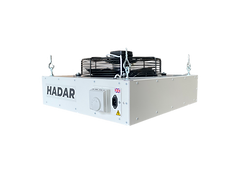
Warm air unit heaters deliver heated air directly into the working area. Suspended from the ceiling or wall-mounted, they can be positioned strategically to provide coverage across the full floor area. Available in gas-fired, oil-fired, LPHW, and electric configurations, they suit small to medium warehouses and zoned heating in larger buildings. For bigger spaces, the Hadar Zephr cabinet heater delivers up to 300 kW (or up to 600 kW in twin configuration) with multi-fuel options including Natural Gas, LPG, oil, and HVO, making it a powerful choice for large warehouses and distribution centres where high output from fewer units is preferred.
Air Rotation Systems
For the largest warehouses and distribution centres, the Hadar Cyclone air rotation system draws air from low level, heats it, and gently distributes it across the entire space in a continuous circulation pattern. This creates very even temperatures with minimal stratification, making it ideal for high-bay storage and buildings where conventional unit heaters struggle to achieve even coverage.
Solution 2: Install Destratification Fans
Even with the best warm air heating, warm air naturally rises to ceiling level in buildings with high ceilings. The Hadar DSF destratification fan solves this by pushing warm air from the ceiling back down to the working level. This recovers heat that would otherwise be wasted at roof height, creates even temperatures from floor to ceiling, and reduces heating costs.
Solution 3: Protect Loading Bay Doors with Air Curtains
Loading bay doors are one of the biggest causes of cold spots in warehouses. Every time a door opens, cold outside air floods in and warm indoor air escapes, creating a cold zone that spreads deep into the building. The Sonniger Guard Pro industrial air curtain creates a high-speed barrier of air across the doorway that blocks cold air from entering and prevents warm air from escaping, improving temperature stability throughout the entire warehouse.
Solution 4: Optimise Heater Placement with a Site Survey
Even the most advanced heating system will struggle if installed without proper planning. Racking, ceiling heights, machinery, and building layout all affect air movement. A professional site survey from Hadar Industries ensures heaters are correctly positioned for full coverage, airflow is directed along aisles rather than blocked by racking, return air pathways remain clear, and potential cold spots near doors and external walls are identified and addressed.
Uneven heating does not need to be an accepted part of warehouse operations. Contact Hadar Industries today to arrange your free site survey and discover how the right combination of warm air heating, air rotation, destratification, and air curtains can eliminate hot and cold spots in your warehouse.